St Michael's through the centuries
The Anglo-Saxon period
From a charter of King Stephen we know that Beccles had been given by King Edwy (reigned 955-9) to the priests guarding the grave of King Edmund of East Anglia at what became Bury St Edmunds. Beccles seems to have been carved out of one of the king’s royal estates; and it is probable that it was already an important place.
The priests were succeeded by a monastic community which built the abbey of Bury St Edmunds in 1020, so Beccles became a possession of the abbey.
St Michael’s was not the only religious building in the town. The Chapel of St Peter faced the original market place, now known as Old Market. The remaining lower parts of the chapel’s two towers, which probably date from the late Anglo-Saxon period, are visible on either side of St Peter’s House. In what is now the south part of the town lay the parish of Endgate with its Church of St Mary, none of which remains.
The Fourteenth Century
St Michael’s as we see it today was largely built in the decades following 1369. when a bequest referring to the ‘new church’ was made by Robert Botild of Mutford. Very little evidence of the previous church building has been found, but the list of rectors starts in 1291 and the bowl of the font is 13th century.
The size of St Michael’s reflects the importance of Beccles as the third town of Suffolk in the Middle Ages.
The Fifteenth Century
The South Porch was built in the middle of this century
The Sixteenth Century
The Bell Tower was constructed in the first half of this century. We do not know whether St Michael’s had had a tower previously or whether one had been planned when the current church was erected. The Tower was probably built in its unusual position because the ground at the west end of the church drops away steeply towards the river. In 1553, not long after the Tower was completed, it was recorded that there were 3 bells.
A disastrous fire in Beccles in 1586 destroyed all the internal woodwork of the church and 80 properties in the town. The red colouring on some of the pillars is thought to be the result of the fire.
The Seventeenth Century
The puritan William Dowsing visited Beccles in the 1640s and ordered the removal of 40 ‘Superstitious pictures’, 13 crosses and various inscriptions which he considered unsuitable. Some of these items were from the South Porch and Tower.
The Eighteenth Century
In the middle of the century a young curate called Edmund Nelson served in the parish. He moved to Norfolk but returned to Beccles to marry Catharine Suckling in St Michael’s. They became the parents of Horatio, later Admiral Lord, Nelson.
In 1762 the then ring of 8 bells was taken down and a new ring of 10 bells was hung.
In 1783 the well-known poet George Crabbe married Sarah Elmy in St Michael’s. Crabbe grew up in Aldeburgh; and much of his poetry describes the Suffolk landscape. Lord Byron called him ‘Nature’s sternest painter, yet the best’. Crabbe knew Beccles well; and some of the characters in his poems may be based on citizens of the town. He trained as a surgeon but became a clergyman and is known to have preached in St Michael’s.
The Nineteenth Century
The church was renovated in 1859. A west gallery that had housed the organ was demolished; the organ was moved to its present position in the north-east corner. The Chancel and Sanctuary were remodelled and the current choir stalls put in place. Radiators and a coke-fired boiler to provide central heating were also installed.
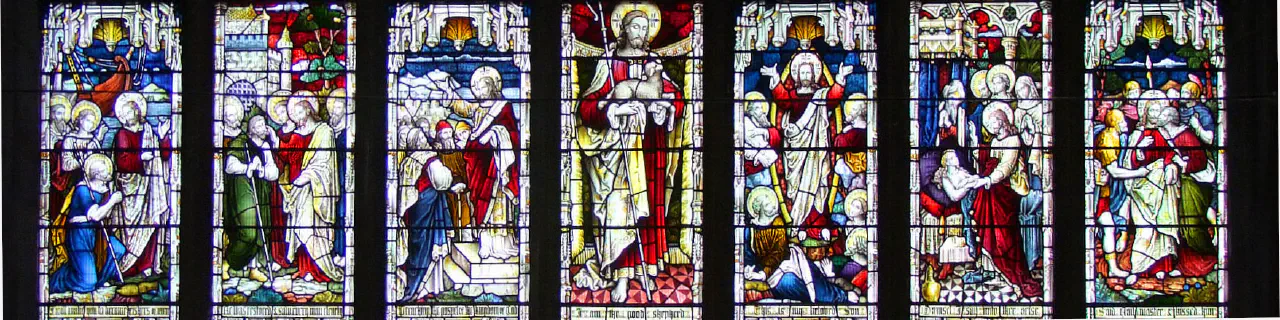
The great east window was provided to commemorate Queen Victoria’s Golden Jubilee in 1887. The archangel St Michael figures prominently, as we might expect.
New pews were bought; and the church could accommodate 1,000 people.
The Twentieth Century
The Chancel screen, having been made shortly before the First World War, was installed in 1919. The Memorial Chapel was created in the south-east corner to commemorate those who had died.
In the 1980s new church rooms were needed as the former church hall in Ballygate had been sold. The church wished to extend St Michael’s on the north side, but this was not allowed, several organisations having objected, so the present Undercroft and the terrace above it were built.
The Twenty First Century
The church has been made more accessible through the extending of the dais at the front of the nave and aisles and the provision of ramps. Some pews at the front and rear have been removed to give more flexibility in the use of the building. A servery and accessible toilets have been provided. The South Porch and Priest’s Door have been conserved outside and in.
When the Victorian central heating system failed, the current electric heating was installed.
A new lectern commemorates the reign of Queen Elizabeth II.