The history of St Botolph's church
Unlike neighbouring Barnby, North Cove was not directly mentioned in the 1086 Domesday Survey. It was then part of Worlingham which was recorded as having 2½ churches (meaning that the patrons of 2½ churches lived here), the remaining half was owned by the lord of the manor of Linburne near Ipswich. The medieval moated site of Wade Hall is nearby, and was home to the Jerningham family who may have been patrons of St Botolphs.
Outside
The core of the church we see today was probably built in the late 12th century and probably on the site of one of the churches mentioned in the Domesday survey. It has remained small, but has undergone many changes since it was built.
A thatched roof stretches over nave and chancel, and the prominent ledge below the eaves marks the original height of the walls. The church is built of cobble and flint with considerable amounts of medieval brick incorporated, particularly in the tower.
The oldest parts of the church are the eastern ends of the south and north walls of the nave, The nave was extended westwards when the tower was built, including moving the fine Norman doorway which is now protected by the later porch. The doorway can probably be dated to around 1180 and has two orders of carving, including the classic chevrons.
Evidence for the westward extension can be seen on the north wall about 5m east of the current door, where the original doorway can be seen as a faint door-shape in the wall partly below the window, where the regular coursing of the stone work is interrupted. A similar opening is less clear in the south wall beneath the window next to the porch.
All the nave windows were replaced in the fifteenth century with flat topped ‘Perpendicular’ examples, but the single brick-built lancet window at the west end of the north wall is a puzzle.
The site of the rood stair, which gave access to the rood loft for the maintenance of the lights in front of the Cross, can be seen on the south wall near its junction with the chancel, where the wall has been rebuilt in brick. These stairs were often built within the thickness of the wall and formed weak points in the structure. When they fell out of use after the Reformation, many were blocked up.
The chancel appears to have been rebuilt, rather than extended, in the late thirteenth or early fourteenth century. The frames of the ‘Decorated’ windows are contemporary with the wall as no signs of insertion joins can be seen. The tracery within the windows was replaced during the Victorian restoration in 1874.
The thin, unbuttressed tower displays a great deal of thin red, and yellow gault, medieval brick, particularly at the quoins (corners), and the small west lancet, belfry lancets and bell openings are also all in brick. The tower is dated by these bricks which may have been locally-made in the fourteenth or fifteenth centuries, or they could have been imported from the Low Countries before this. Close to the coast, examples of these imported bricks are known from the late-thirteenth century.
The tower quoins also illustrate clearly the amount of building work done each year. This was normally limited to between 4 and 6 feet each year and changes of material clearly show where work started and finished.
On the north side of the tower are the remnants of a blocked doorway which is partially obscured by the west wall of the nave which must have been rebuilt at some time after the tower was
Entry is by way of a porch on the south side. The front wall of the porch shows extensive rebuilding, but there are still remnants of flint flushwork in the plinth and on the buttresses. There is also a hole in the wall on the right of the doorway for a scratch dial which displayed the service times. A peg was put in the hole and its shadow marked the time of day — a sort of primitive sundial, whose function obviously ceased when the porch was built.
Inside
The remains of the upper door of the rood stair can just be seen high above the pulpit.
The Medieval Wall Paintings
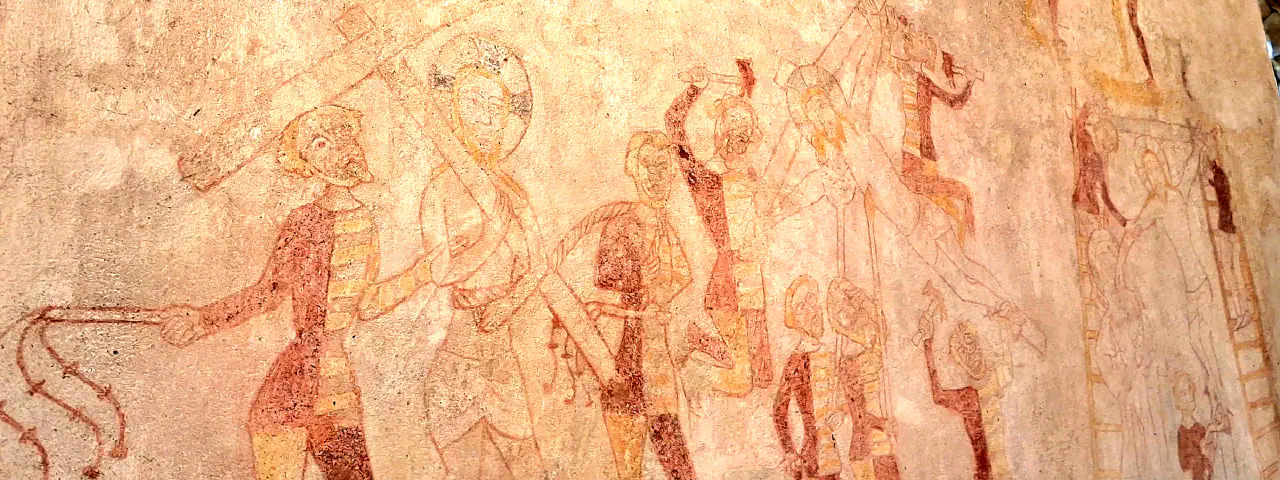
The real glory of St Botolph’s is the series of wall paintings which are now thought to have been painted in the 14th century. Restoration work on the wall paintings commenced in 1983, and was completed in 1986. It involved removing years of dirt and grime, then removing earlier renovation work carried out in the 19th century.
The cleaned paintings were very faint, but many more of the 14th century lines became visible during the cleaning process. All the thin medieval colours were very carefully reinforced with water-colour paint following each original line precisely.
The paintings are on both sides of the chancel and show the events before and after the Crucifixion. On the north wall from the left you can see the Entry into Jerusalem; the Last Supper with table covered by a sumptuous cloth and spread with dishes of fish and bread; the journey to the Crucifixion with the scourging and mocking of Christ carrying His cross; Christ being nailed to the Cross; the giving of the sponge of vinegar and longines piercing Christ’s side.
Also depicted is the Deposition from the Cross; and the Resurrection with Christ apparently emerging from a stone coffin attended by strangely-armed soldiers. On the right is the Harrowing of Hell (Christ standing in the mouth of Hell), the release of the souls of the damned from Hell, portrayed by the savage jaws of a great fish.
On the south wall is the Ascension, with the Virgin and Apostles below, our Lord’s feet disappearing into the clouds above. The Doom or Last Judgement shows Christ in Majesty, seated on a rainbow, flanked by the Virgin Mary and St John the Baptist, with two attendant angels thought to be holding symbols of the Passion (cross, lance, nails).
Below are four trumpeting angels blowing a last trump with souls arising from their graves and coffins. To the east is a small angel guiding the blessed souls to Heaven, and to the west a figure being guided up the steps to heaven on one side, and the naked condemned being driven to outer darkness by St Michael on the other. Intertwining amongst them all is the vine, believed to be the symbol of St Botolph, patron saint of the church.
The seventeenth- or eighteenth-century circular texts painted on the walls replaced wall paintings after the Reformation. They were rediscovered in 1937 when the church was cleaned, which is why they are partly covered by later memorials.
Piscina and Sedilia
The medieval basin for the washing of the vessels after Mass and the seats for the clergy during the long medieval services are located in the south wall of the chancel, although the piscina appears to have been moved upwards when the sanctuary floor was raised during the Victorian restoration.
Font
The early fifteenth-century beautifully carved lion font is in good condition, its shaft ringed with eight attached small columns or pillars and raised on a plinth. Fine heads with head-dresses contemporary with the time are carved below the bowl, and are similar to those at neighbouring Mutford and Gisleham. The panels contain alternately demi-angels bearing shields and curiously cramped lions; there are traces of colour.
Memorials
There are monuments set into the chancel floor to the Singleton and Rede families from the fifteenth to the seventeenth centuries, and fine marble nineteenth century wall memorials to the Farr family.
The stone altar table or “mensa” with five consecration crosses, is also let into the chancel floor. Mensas were removed and replaced by Communion tables during the sixteenth century.
Unusually, in the east end of the nave floor are several small slabs of Purbeck ‘marble’, these may be the remnants of other early grave slabs.
Ian Hinton — Norfolk Historic Buildings Group